
Van Buren Public Schools invited 300 educators and administrators from across the district to an AI Professional Learning Day on Aug. 27 at Belleville High School.
Facilitated by the Michigan Association of Secondary School Principals (MASSP), the day focused on integrating artificial intelligence technology into administrative duties and classroom activities.
Aaron Baughman, MASSP associate director of innovation and strategic partnerships, began the day with a keynote presentation emphasizing how AI can streamline educational tasks and provide more accessible opportunities for students in underrepresented and under-resourced areas.
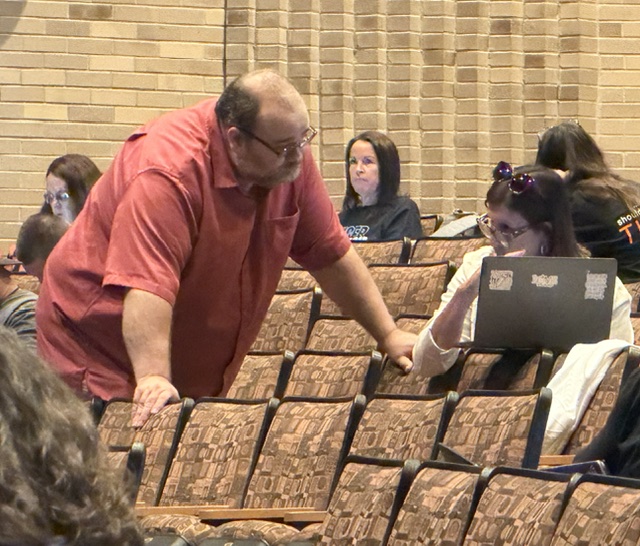
Following the keynote, attendees were given the opportunity to select four “Learning Lab” workshops from a roster of 23 specialized options. Topics included “Turning AI Possibility Into Practice,” “Elementary Digital Literacy” and “AI in Special Education as an Equity Accelerator,” among others.
Going forward, the district will exclusively use Google Gemini alongside SchoolAI, a platform designed specifically for K-12 offering guided prep tools for teachers and real-time, guardrailed tutoring for students. Among its benefits, the platform provides live visibility into how students are learning, so educators can step in at the right moment rather than after the fact.
SchoolAI was designed with data privacy in mind. Logging in with school credentials will give users access to customized, secure AI models, with all data stored on servers located in the contiguous United States. It is compliant with both the Family Educational Rights and Privacy Act (FERPA) and the Children’s Online Privacy Protection Act (COPPA).
The district is not implementing AI just for the sake of having new technology. Van Buren Public Schools Director of Curriculum and Instruction Jill Marvaso said the district “sees it as a way to give our educators time back and to personalize learning for every student.”
Baughman echoed those sentiments and emphasized just how much time can be saved by using AI to handle the more time-consuming administrative tasks, explaining that educators can save, on average, at least 8 to 10 hours a week, giving them “time back in the classroom with their kids or time with their families, or a little bit of both.”
Baughman reported that he receives mostly positive feedback from teachers and administrators. That is not to say that the district does not have concerns, but it is proactive in addressing them. Its top priorities are data privacy, student safety, academic integrity, professional development and ensuring every classroom has equitable access and training.
Among attendees, reviews were mixed. A teacher who preferred to remain anonymous commented that they feel it is a “confusing example to set for the kids” at a time when students are being encouraged to build their own intellect and skills without reliance on AI.
David Turner, assistant principal at McBride Middle School, believes that while students absolutely need to know how to survive without AI, it would be a mistake to leave it out of the curriculum entirely. “If we don’t teach our kids to use it, then we set them up for failure, so I think there needs to be a balance,” he said, adding “we need to utilize it in a way that gives them the skills they’re going to need with and without it.”
Baughman and MASSP will be returning to Van Buren Public Schools on at least three future dates, stating that this is a long-term process. They have built out the usage guidelines and made them available to students and parents, and are incorporating AI in the education process. The next step will be innovating processes and determining how to continue incorporating AI effectively and responsibly.
I couldn’t help but notice the irony of reading about activists protesting AI on one page of the Independent, only to turn the page and discover Van Buren Public Schools training 300 educators and administrators to incorporate AI into our schools. LOL!
I’m not opposed to AI. In fact, I think it’s an incredible tool when used appropriately. But I do have some questions.
We’re told AI can save educators 8–10 hours per week. That’s a pretty significant claim. Where is the supporting data, and how does the district intend to measure those savings?
More importantly, how will this technology improve student achievement? Will we see measurable improvements in reading, writing, mathematics, and critical thinking?
I also wonder how much this initiative is costing taxpayers, including software subscriptions, training, and ongoing implementation.
Technology should enhance education, not become a substitute for developing fundamental skills. Students need to learn how to think independently, solve problems, and function without relying on AI to do the work for them.
I’d like to see the district establish clear, measurable academic outcomes and demonstrate that this investment actually benefits students.
After all, the goal isn’t to produce students who are proficient at using AI. It’s to produce students who are proficient at learning, reasoning, and thinking for themselves.